
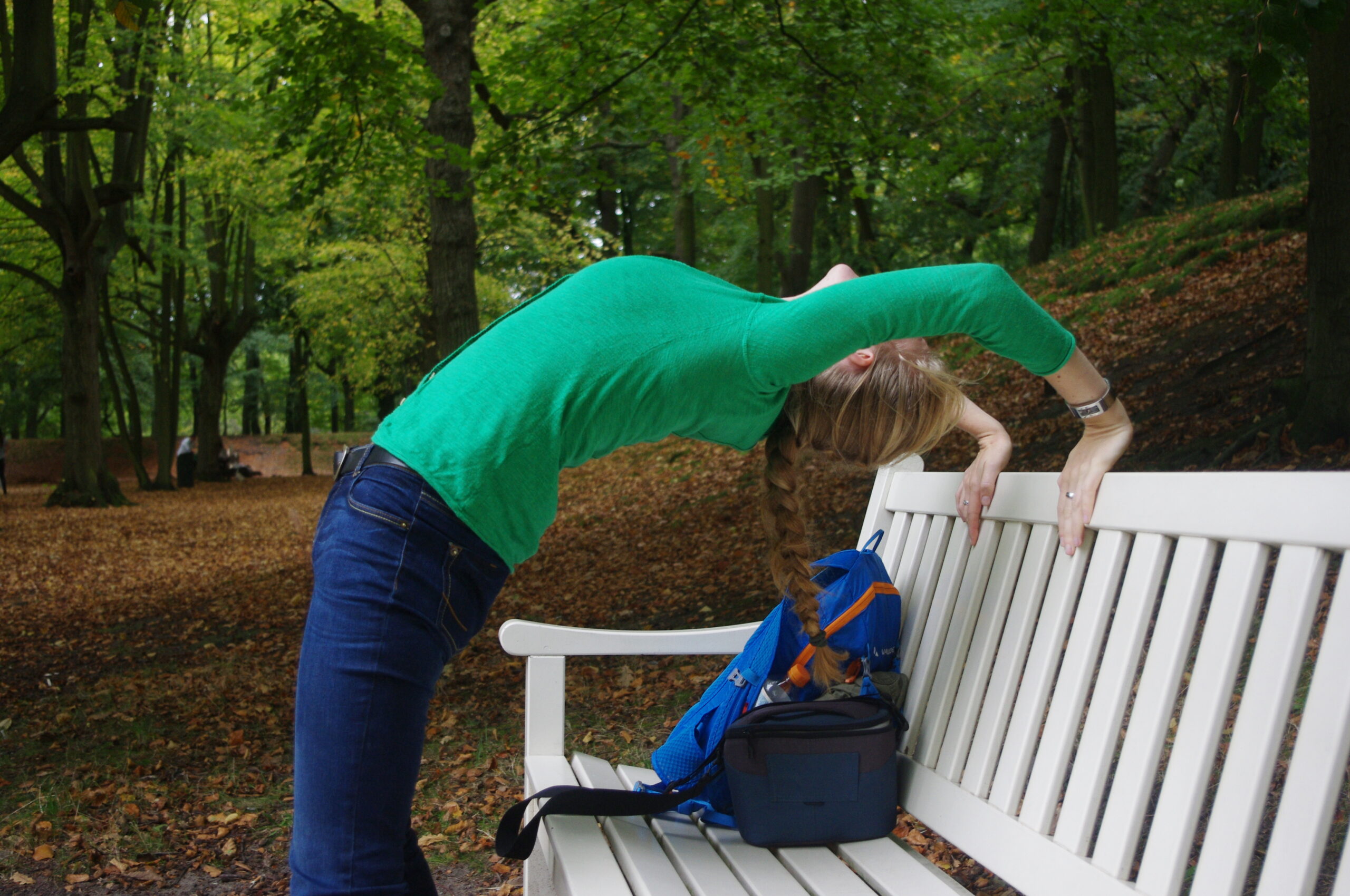
People need to move to stay mobile, but how we move is a result of different things, for example, our moving behaviours in the past and the environment we are in now (Bowman, 2017). Quite some attention is paid to, for example, changing the way we transport ourselves and how to make the sustainable choice the more likely one, with questions such as ‘how do we get people out of the car and into public transport’ and ‘how do we get people to walk to nearby destinations’ rather than using a car. However, I am not talking about movement as transport, but about how we move our body and body parts; how do we move our feet, legs, backs, arms, and heads, while we are walking, sitting, playing, and working. And when we sit, which chairs do we use, when we walk, which shoes do we wear, and what is the material of the surfaces we are walking on? And where are things we use, relative to each other?
Kitchen design changed substantially in the last century to be more efficient. Cupboard sizes were standardised, appliances were fitted in, and all the actions were grouped together to minimise space use and distances between actions, to make meal preparation more efficient. Today, the tasks necessary for preparing meals take less time (also consider how culture changed how we prepare and eat our meals) and add to that all the kitchen machines we have nowadays. So, yes, efficient in the sense of time, and probably space, but not from a biomechanical or social point of view. And, comfort is not the same as health; a comfortable chair may not be healthy for you, especially if it keeps you in the same position for a long time (Liu et al., 2023). The kitchen was separated from other living spaces, which meant that connections to other activities or people in the home would be separated. It would be difficult to keep an eye on your kid’s activities, entertain guests, or have a conversation with your partner about the plan for the evening, while preparing a meal. The open kitchen design has gained popularity since the second half of the last century and now it does make connecting these activities a bit easier. However, the movements made in the kitchen have simplified too, which does not have a positive effect on our bodies. There is a machine or tool for almost everything, which influences what movements you make in the kitchen. Similar for the standardisation of kitchen cupboards, no matter which kitchen, you can assume similar postures for multiple activities (for example, washing, cutting, stirring, and peeling) because the surface has the same height and depth (Bowman, 2017).
We have separated being at home from physical activity and movement. How many different movements do you make at home? How does that add to your total of different movements in a day? Take sitting for example. We have designed chairs to sit in, which should support the ‘right’ body posture, but any posture is bad if we stay in that position for too long. Looking at computer and phone screens (while sitting or standing) can lead to shifting your head forward relative to your spine, causing neck pain and head pain. But it goes further than that. Tilting your head forward means that you need to compensate your balance with your jaw and spine, so it is not just your head and neck which are affected, but your whole body, every time this happens (Tsantili, Chrysikos, Troupis, 2022). Culture plays a role as well, where we are expected to sit in chairs, with our feet down to the floor, especially when not at home. You would think twice about sitting cross-legged in your office chair at work. We have designed our environments to fit our cultural expectations, which are to sit still in specific positions for most of the time, and to move in very specific ways for only small parts of the time in specific environments, such as a gym. The concept of affordances describes the possibilities an environment or object affords which is also shaped by culture (Gibson, 1974). We may perceive that the floor in a building affords sitting, but most people would not sit (but stand) on the floor under ‘normal’ circumstances. However, sitting down and getting up from the floor are movements that most of our bodies could benefit from (Bowman, 2017). Why do we not sit down on the floor, but we do spend 30 minutes sitting in the car while driving to the gym? The variability of movement that can be integrated in our daily life is disappearing from our culture, because movement is conceptually separated from other activities (going from place to place, working, relaxing, cleaning, playing, etc.). Why is this a problem? Because our bodies need to move to stay healthy, both physically and mentally. Framing movement as something specifically for athletes or ‘sporty’ people, and limiting the cultural acceptance to move only to sports and sports environments, is not a good idea given the current average health of people. For American youth for example, the last decade the amount of movement per day has been decreasing even further from the set guidelines (Chen et al., 2024) and there is no reason to think this trend may be different elsewhere or for other groups of people.
So how can we change the design of our everyday environments to increase the variability of movement? We could think about the materials used for paths and streets, and inside our buildings. For example, instead of using asphalt or tiles outside, it might be possible to use sand, shells, or a different type of stone for the tiles with some relief. We could play with height differences, where possible, keeping in mind accessibility as well. For the interior of buildings, carpets from different materials could be used, and differences in hardness, and again, heights. Considering the question of sitting, different types of chairs or seating areas can be designed; high chairs, low chairs, soft chairs, hard chairs, chairs that move, and no chairs (for the brave!). For these changes to happen, it is important to allow time for moving. It is ok to take 5 seconds more when sitting down on the floor, as it helps you to move in different ways, which, in time, should increase your overall health; it is ok to leave a bit earlier so you can walk, run, or parkour to school, work, or the gym. It is time to creatively include movement in architectural and urban design and to start appreciating (rather than dread) all the movement options our environment affords us.
References
Bowman, K. (2017). Move Your DNA: Movement Ecology and the Difference Between Exercise and Movement. Journal of Evolution and Health: A joint publication of the Ancestral Health Society and the Society for Evolutionary Medicine and Health, 2(3). http://dx.doi.org/10.15310/2334-3591.1077
Gibson, J. J. (2014). The ecological approach to visual perception: classic edition: Psychology Press.
Liu, Y., Hu, W., Kasal, A., & Erdil, Y. Z. (2023). The State of the Art of Biomechanics Applied in Ergonomic Furniture Design. Applied Sciences, 13(22), 12120. https://doi.org/10.3390/app132212120
Tsantili AR, Chrysikos D, Troupis T. Text Neck Syndrome: Disentangling a New Epidemic. Acta Med Acad. 2022 Aug;51(2):123-127. doi: 10.5644/ama2006-124.380
Chen S, Brown D, Parker K, Lee E-Y. Trends in adherence to the 24-h movement guidelines among US adolescents from 2011 to 2019: Evidence from repeated cross-sectional cycles of the Youth Risk Behavior Surveillance System. Scand J Med Sci Sports. 2024; 34:e14609. doi:10.1111/sms.14609